
An insight report: Integrating neuro-affirming design principles for sports flooring in Australian schools
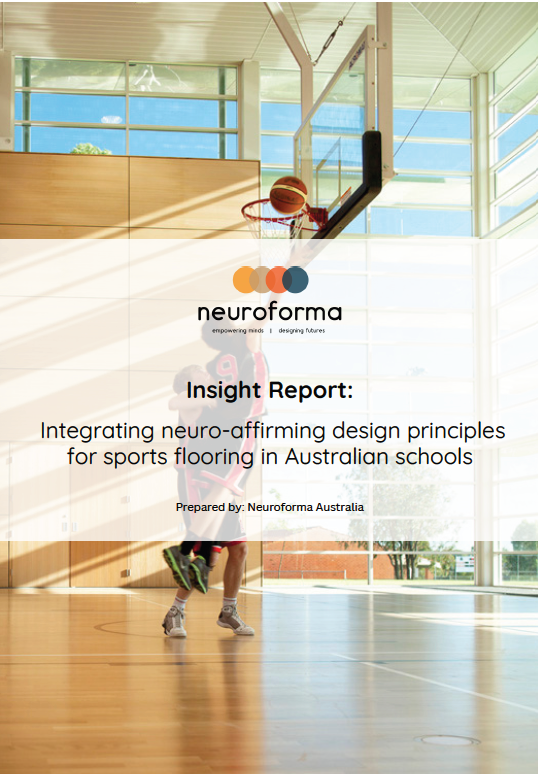
Sport plays a vital role in Australian schools, supporting physical health, social connection, confidence, and wellbeing. Yet for many students, particularly those who are neurodivergent, sports environments can feel overwhelming rather than welcoming. While much attention is given to coaching, participation programs, and curriculum, the design of the physical environment itself is often overlooked. Sports flooring, one of the most dominant elements in a school hall, has a powerful influence on how safe, calm, and accessible these spaces feel. Integrating neuro-affirming design principles into sports flooring offers an opportunity to rethink school sport environments so they support participation, comfort, and inclusion for every student.
Neuroforma has released an insight report exploring the integration of neuro-affirming design principles in sports flooring for Australian schools. The following is a brief overview of its key insights and conclusions.
Designing sports floors that are neuro-inclusive: Shifting the focus from performance first to people first design
Sport has long been central to Australian school life. It supports physical health, builds confidence, strengthens social connections, and fosters a sense of belonging.
Traditionally, sports flooring in schools has been specified around durability, safety, and performance compliance. Timber sprung floors, vinyl systems, and polyurethane surfaces are typically assessed against criteria such as shock absorption, ball bounce, slip resistance, and lifecycle cost. These factors remain essential, but they are no longer sufficient on their own.
Contemporary education design is increasingly shaped by inclusion, accessibility, and wellbeing. With an estimated 15–20% of students identified as neurodivergent, learning and activity spaces must respond to a wider spectrum of sensory, cognitive, and physical needs. Flooring, as the most expansive surface in a sports hall, plays a critical role in shaping how safe, calm, and legible that space feels.
Understanding neuro-affirming design in sports environments
Neuro-affirming design recognises neurological differences, such as autism, ADHD, dyslexia, and sensory processing differences. In sports halls, these differences often intersect with heightened sensory input: echoing acoustics, glare from polished floors, visually complex timber grain, overlapping line markings, and unpredictable underfoot feedback.
For some students, these conditions can lead to sensory overload, anxiety, reduced spatial confidence, or withdrawal from participation altogether. A floor that appears technically compliant may still feel overwhelming or disorienting.
Neuro-affirming sports flooring aims to reduce these barriers by prioritising:
visual calm and clarity
predictable, stable underfoot performance
reduced glare and reflections
controlled acoustics and vibration
intuitive wayfinding through clear line marking
Importantly, these strategies benefit all users, not just neurodivergent students.
What does neuro-affirming sports flooring look like?
In an educational context, a fit-for-purpose sports floor must do more than withstand wear. It must support a wide range of activities, users, and sensory experiences over decades of use.
A neuro-affirming floor balances:
Safety – shock absorption, slip resistance, smooth transitions
Durability – long-term mechanical, functional, and visual performance
Accessibility – continuity, clear markings, mobility support
User experience – comfort, confidence, and visual legibility
When acoustic performance, tactile quality, and visual comfort are considered alongside traditional performance metrics, the floor becomes a foundation for inclusion rather than a hidden barrier.
The hidden challenges of timber sports floors
Timber remains a popular choice in Australian schools, valued for its resilience, tradition, and aesthetics. However, not all timber systems perform equally in neuro-inclusive environments.
Natural variation in colour and grain, particularly in mixed Australian hardwoods, can create visual “noise” that interferes with depth perception and spatial orientation. High-gloss coatings amplify glare and reflections, while expansion gaps required by many solid strip systems can interrupt visual continuity and underfoot predictability.
These characteristics are not defects, they are inherent properties of the material. But when used without consideration of sensory impact, they can unintentionally exclude some students from fully engaging in sport.
A Four Tier Framework for Neuro-Affirming Sports Flooring
To address these challenges, the report proposes a Four Tier Neuro-Affirming Sports Flooring Framework, based on design performance rather than cost:
Tier 1: Seamless synthetic systems
Polyurethane resin or seamless vinyl floors with matte finishes offer the highest level of visual consistency, low reflectivity, excellent shock absorption, and minimal sensory triggers.
Tier 2: Engineered timber systems
High quality engineered floors using plantation-grown species such as European Oak or North American Maple provide warmth and durability while maintaining dimensional stability and visual calm, when finished in low gloss coatings and installed without intermediate expansion voids.
Tier 3: Solid strip timber
First grade solid timber systems can perform well but require careful detailing. Expansion gaps and surface interruptions may reduce suitability for neuro-affirming environments unless managed meticulously.
Tier 4: Mixed Australian hardwoods
While structurally robust and locally sourced, Australian hardwood floors can present challenges from a neuro-affirming perspective due to high visual variability, multiple expansion voids, and potential long-term gapping.
Crucially, the framework is not cost based. In many cases, Tier 1 and Tier 2 solutions deliver superior inclusive outcomes without being the most expensive options.
Small design decisions, big inclusion gains
Some of the most effective neuro-affirming strategies involve little or no additional cost. Clear separation between court lines, thoughtful hierarchy in multi court layouts, matte finishes, and coordinated lighting can dramatically improve visual legibility and wayfinding.
Similarly, engaging neurodivergent students and educators in design decisions, and conducting post occupancy evaluations, ensures that flooring performs as intended in real world use, not just on paper.
A call to action for Australian schools
Australian schools are well positioned to lead the next generation of inclusive sports environments. Doing so requires a shift in mindset, from asking whether a floor meets minimum standards, to asking who it truly works for.
The report calls for:
nationally recognised inclusive line-marking standards
accredited neuro-inclusive design guides for school sports facilities
continued research into the relationship between flooring, sensory experience, and participation
When sports flooring is designed with inclusion in mind, the result is more than a durable surface. It is a space where every student feels safe, confident, and welcome to participate.
To request a copy of the report, contact us at info@neuroforma.co